Doctrine.
Scholarship.
CONSEQUENCE.
The work of Jamarlon J. Glenn, independent scholar, professional genealogist,
and architect of the R.B.I. Wisdoms doctrine.
THE STATEMENT

Jamarlon J. Glenn was raised in Rockisle, Texas. By age eleven he was already in business, cutting yards, ironing jeans, selling Kool-Aid to pay for the things his mother could not afford. He was an all-state running back and a top student. His father received a twenty-four-and-a-half-year federal sentence and died of cancer while incarcerated. His twin brothers received life sentences and were pardoned by President Obama after twenty-five years. In seventh grade his brother was murdered, doused with gasoline, and burned alive in an abandoned house in Mississippi.
He has navigated the consequence of two helicopters in his backyard and a one-and-a-quarter-million-dollar bond. He has navigated eighteen years of original archival research across the parish courthouses, Catholic registers, and federal census records of Southwest Louisiana. He has navigated the rebuilding required to operate as scholar, founder, and family head simultaneously.
The work assembled on this site is not theory. It is the codified output of a life that earned the right to make claims about how systems work, how families restore themselves, and how the rare mind operates under pressure.
THE WORK
ITHE DOCTRINEThe fifteen-chapter operating system for the rare mind. Inputs, context, and hidden variables resolved into outcomes. |
IITHE LAWSControlled: Laws for People Who Have No Room for Error. The second volume. Released thirty days after the first. |
IIITHE SCHOLARSHIPEssays on Louisiana Creole identity, colonial historiography, genealogy, and the cognitive science of consequence. |
IVTHE DOCUMENTARYRoots That Moved. A film tracing the migration corridor from St. Landry Parish to East Texas. In development. |
THE FLAGSHIP
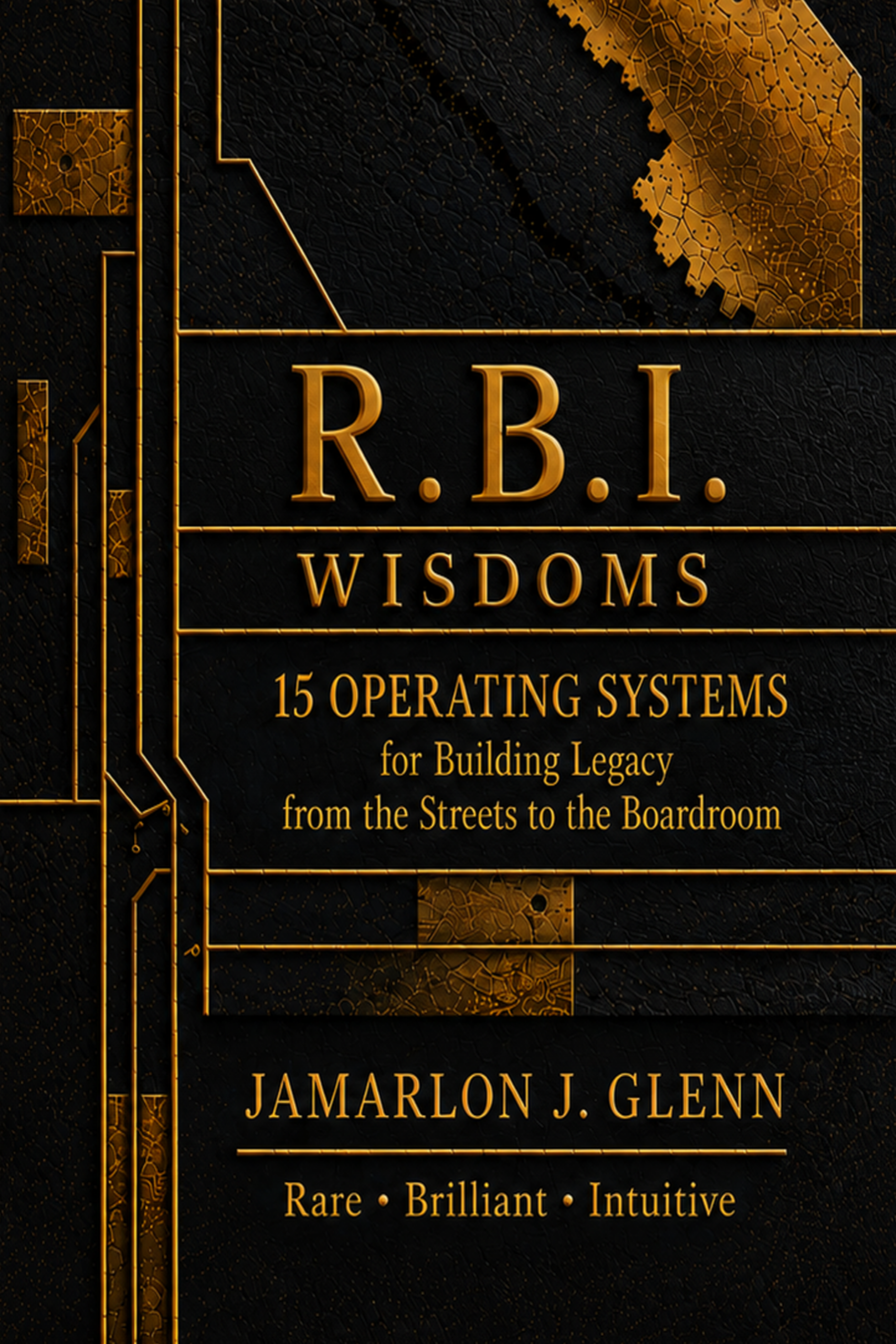
R.B.I. Wisdoms
Rare · Brilliant · Intuitive
Not a memoir. Not a self-help book. A manual.
Fifteen chapters that name the laws by which a person who has no room for error must operate. Each chapter holds four layers at once, the street reality, the business system, the historical precedent, and the psychological mechanism, because the rare mind does not have the luxury of being right in only one domain.
This is the work the corporate world will license. This is the work the correctional system will require. This is the work the family inherits.
NOTIFY ME WHEN IT SHIPS
One essay every two to four weeks. No filler. No marketing.
THE SCHOLARSHIP
Long-form essays in cultural history, genealogy, and applied cognitive theory.
On Cajun as a Constructed Category
How a nineteenth-century French settler designation was retrofitted as a twentieth-century ethnic identity, and why the genealogical record refuses the conversion.
READ THE ESSAY →
The Doctrine of the Manual
Memory is the record of what happened. The manual is the instruction for what to do next. The first is history. The second is sovereignty.
READ THE ESSAY →
Liberty County and the Migration Corridor
Tracing the Louisiana to Texas pipeline through the 1860 Population Schedule, the Slave Schedule, and the Texas General Land Office grants.
READ THE ESSAY →
Subscribe to receive each new essay on release.
One essay every two to four weeks. No filler. No marketing.
The Missing Variables Foundation
The variables a person is given do not equal the variables that decide the outcome. The Foundation exists to surface the missing ones for the formerly incarcerated, for the youth raised in absence, for the family carrying a legacy it did not choose.
REENTRY
YOUTH DEVELOPMENT
FAMILY RESTORATION
LEGACY PRESERVATION
FOR INSTITUTIONS
Licensing and Corporate Training
R.B.I. Wisdoms is licensed to correctional systems, executive development programs, and reentry organizations as a cognitive reconstruction curriculum. The doctrine is delivered through manuals, instructor certification, and an executive assessment instrument validated by an industrial-organizational psychologist.
The framework operates without the founder present in the room. That is the design.
CONTACT
GENERAL INQUIRIES |
MEDIA & SPEAKING |
LICENSING & PARTNERSHIP |